Featured
Diet Guidelines During Treatment with Braces
How to eat comfortably and successfully during your orthodontic treatment with braces or aligners
Read article



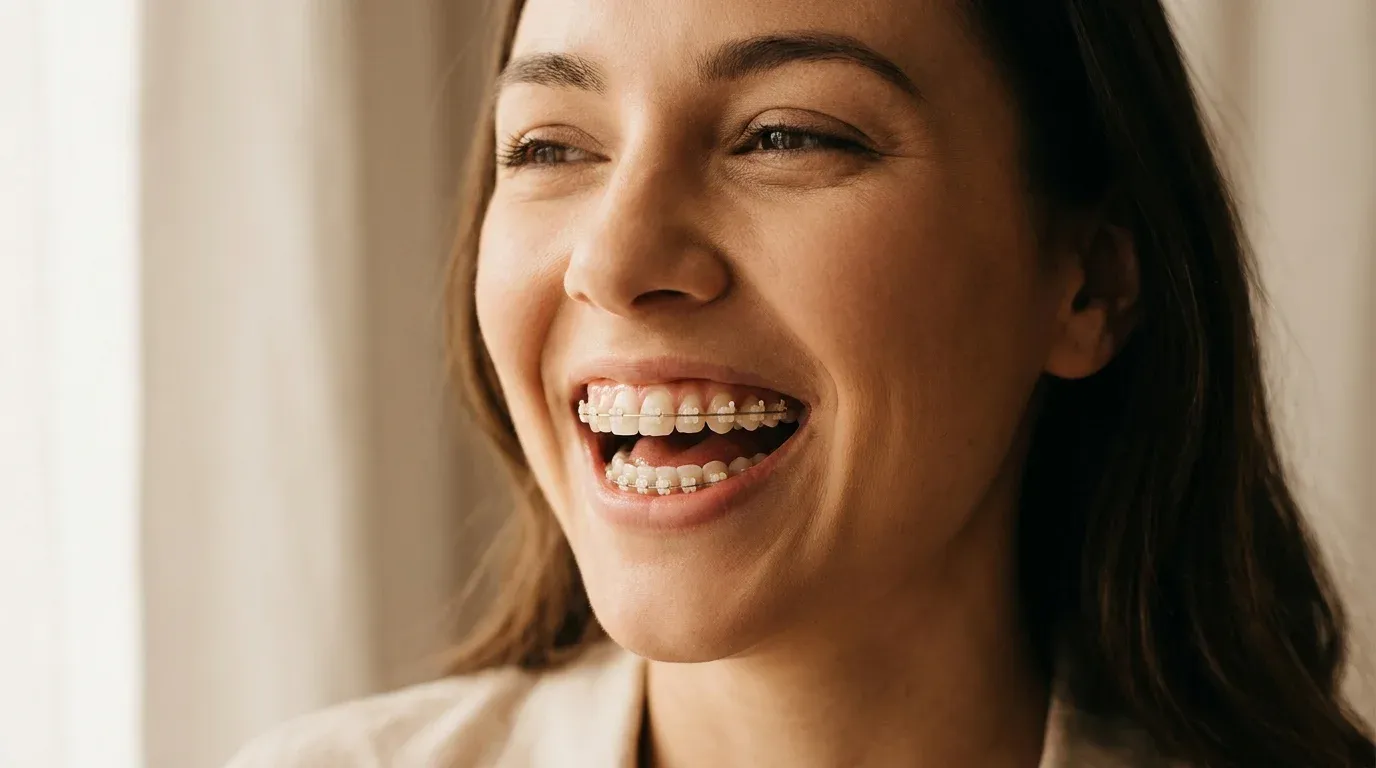
Fixed braces: Dr. Hakim from Frankfurt explains metal and ceramic brackets, lingual braces, oral hygiene, diet & treatment duration. Schedule your consultation now!
Fixed braces – but which ones? I hear this question in my practice almost every day. Because “fixed braces” has long stopped being a single product: there are conventional and self-ligating brackets, metal and ceramic, lingual versions, and fixed appliances with an entirely different job.
I am Dr. Mohammad Hakim, specialist orthodontist in Frankfurt. In this article I go through, step by step, which fixed braces exist, how they differ, how to care for them day to day, and how long treatment realistically takes.
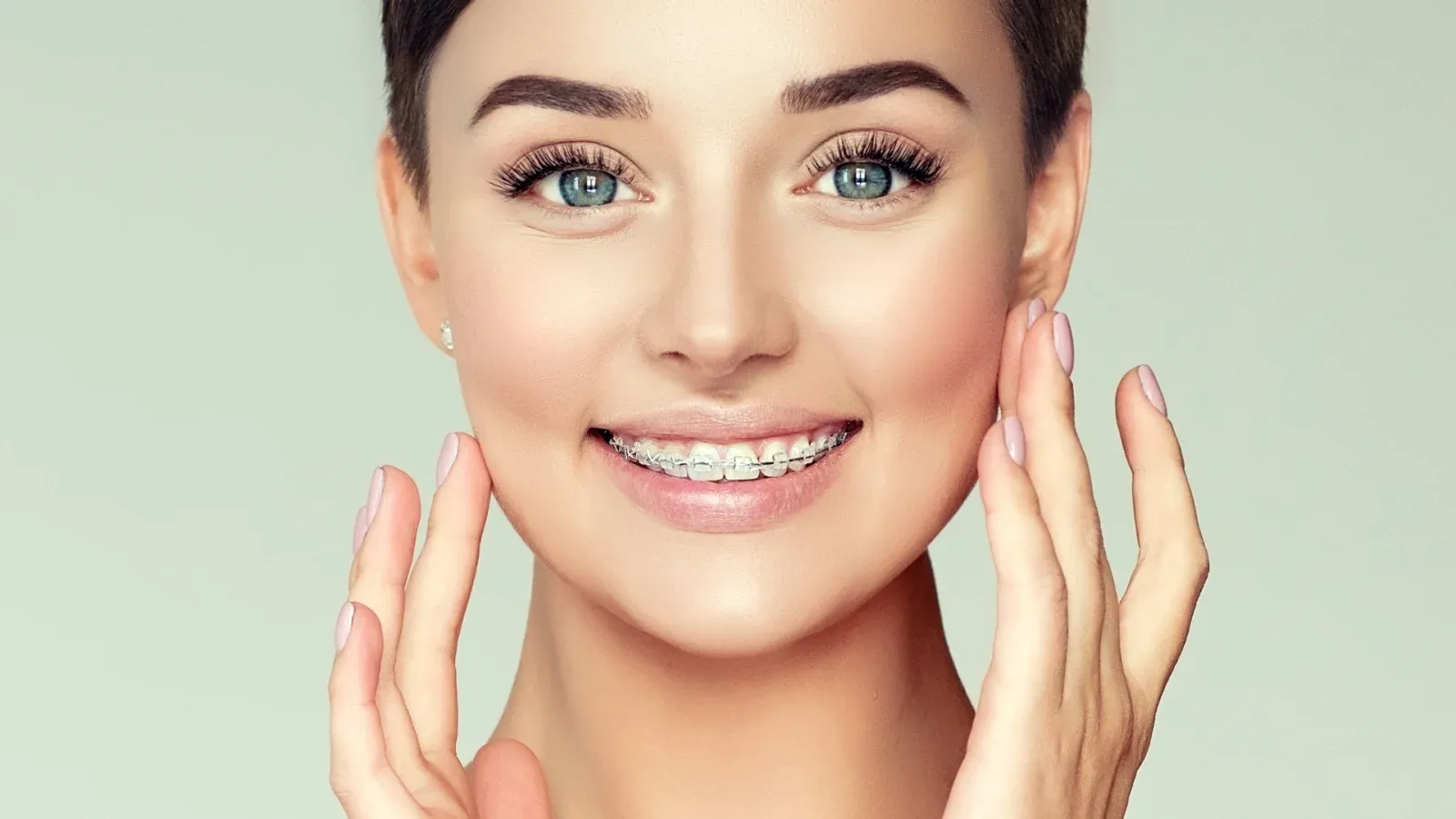
All fixed braces work on the same principle: a small plate – the bracket – is bonded to each tooth. An archwire runs through the brackets, and it is this wire that moves the teeth. It wants to return to its original shape and takes the teeth along with it. What differs between the variants is the material and the way the wire is held in the bracket.
The best-known version. The archwire is held in each bracket by small elastic rings – the ligatures. They come in many colors, which is a source of considerable delight among children and teenagers. They are replaced at every check-up.
Here a small clip mechanism in the bracket itself does what the elastics normally do: it holds the archwire on its own. No ligatures are needed. Self-ligating brackets are available both in metal and in the white ceramic version.
Ceramic brackets are tooth-colored and therefore far less noticeable than metal. We often combine the two: ceramic in the visible front section, metal on the back teeth where hardly anyone looks anyway. That is a very practical solution for adults who do not want to give up the stability of metal.
These braces sit on the inside of the teeth and are simply invisible from the outside. Functionally they work exactly like braces on the outside: brackets inside, wire inside, ligated either with elastics or self-ligating. Planning and manufacturing them is more demanding, because the inner surfaces of teeth vary considerably in shape.
Not every fixed appliance straightens teeth. A palatal expander, for example, is also anchored firmly in the mouth, but has an entirely different goal: creating width in the upper jaw. For the sake of completeness it belongs in this list – just in a category of its own.
Which version suits you depends on your tooth position, your daily life, and how visible the treatment is allowed to be. For teenagers, orthodontic treatment is covered in part by German statutory health insurance under certain clinical criteria; what applies in your case is something we clarify in a personal consultation.
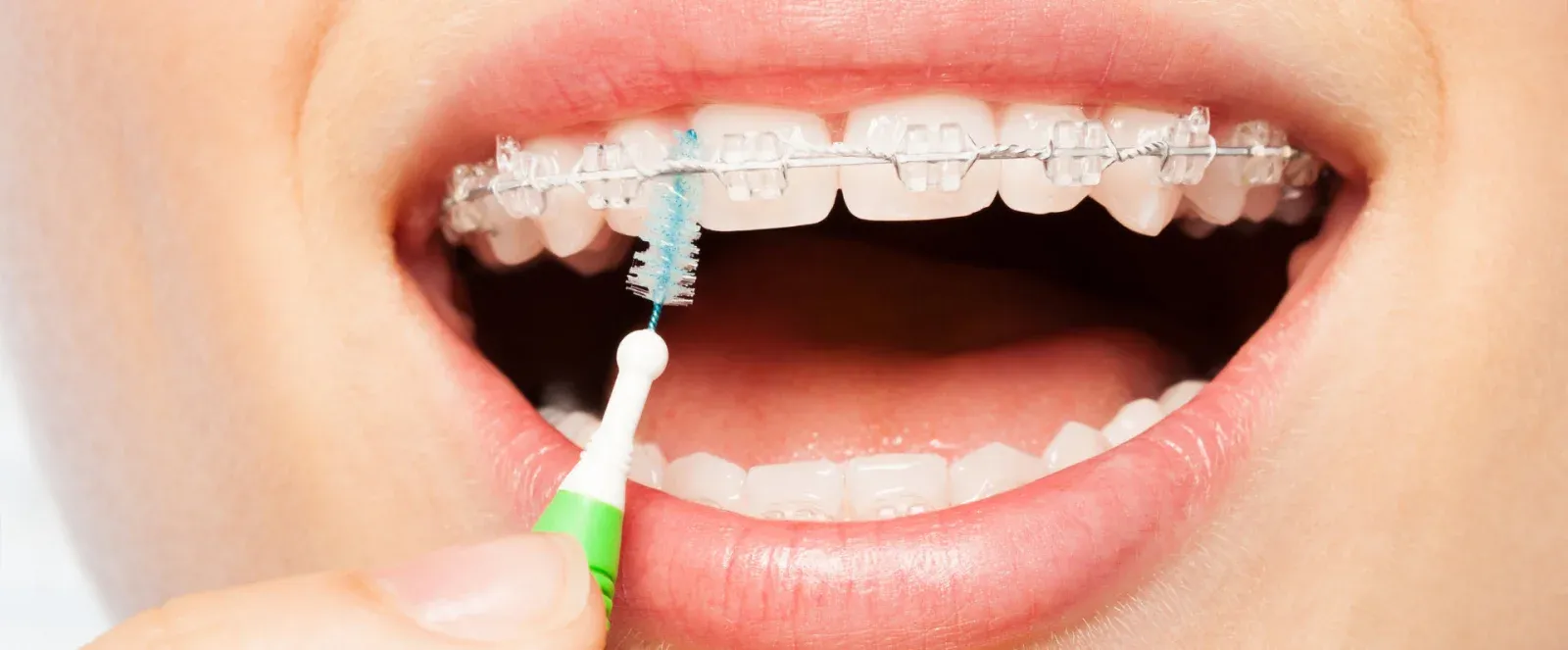
This is the point at which treatment becomes either genuinely smooth or genuinely tedious. You cannot remove fixed braces – and wherever bracket, wire and tooth meet, deposits build up more easily than on a smooth tooth surface. With lingual braces this is especially true.
The critical spot is the transition between bracket and gumline. That is where most of it settles, and it is exactly where people brush least thoroughly.
Here is how to go about it:
Why I insist on this: with fixed braces, more simply accumulates, and that can lead to cavities and gum problems. Both are avoidable – it takes only a few more minutes a day than before. I have covered this in more detail in Oral Hygiene for Brace Wearers.
There is only one rule here, and it is easy to remember: do not bite straight in.
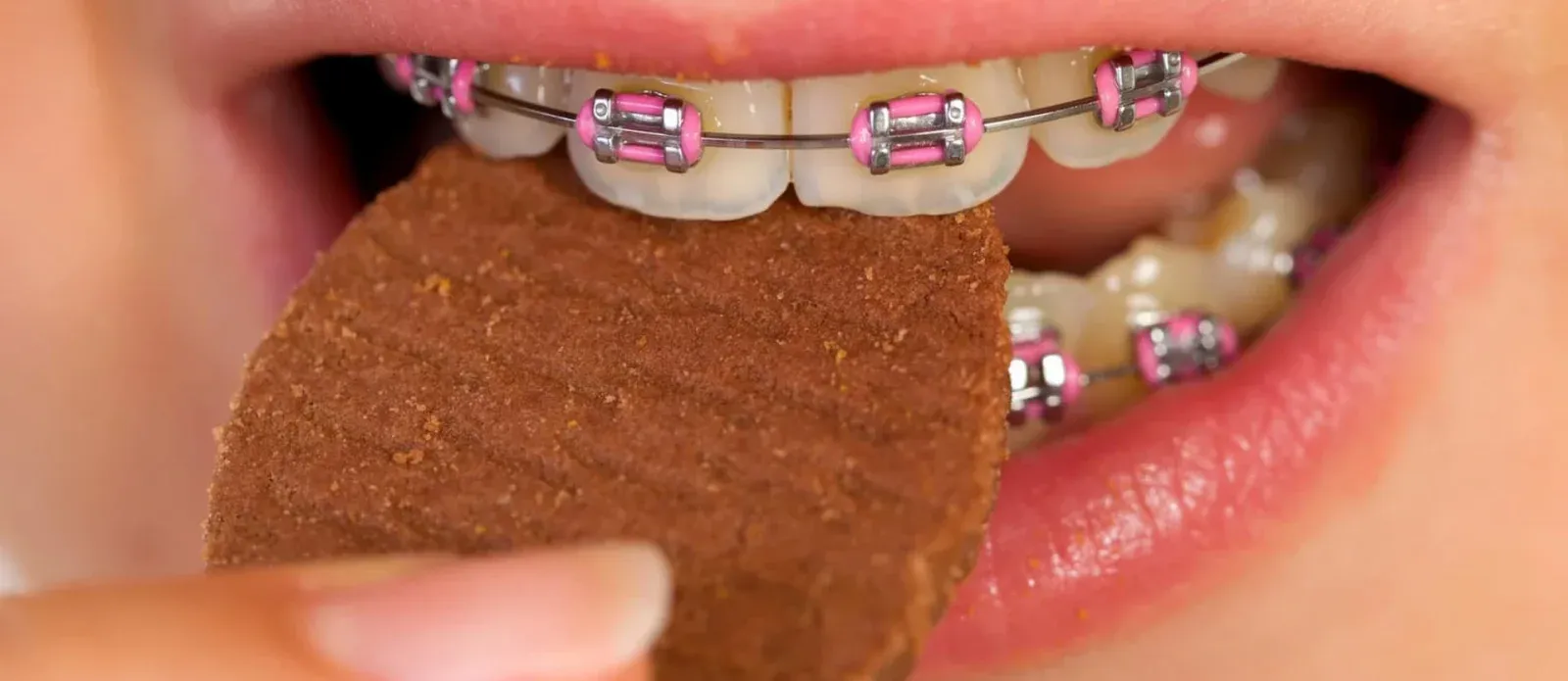
Hard and sticky foods are the problem – the whole apple, the crusty bread, the chewy chocolate bar. Not because you are not allowed to eat them, but because a bracket can come off when you bite. And every loose bracket costs an extra appointment and treatment time.
The solution is unspectacular: cut things up first, eat slowly, and chew with your back teeth. That way the braces stay where they belong and treatment moves along faster. The foods that cause the most trouble in practice are listed in Eating with Braces: Diet Guidelines.
The archwire is usually changed every eight to twelve weeks. These appointments serve two purposes: they move the treatment forward – each new wire sets the next impulse – and they are the moment when I check that everything is going according to plan.
There is one exception. When we close gaps with elastic chains, we see each other more often, roughly every two to three weeks. Elastic chains lose tension over time; if they are renewed too rarely, the movement stalls. Once the gaps are closed, we return to the usual rhythm.
Over the course of treatment you will encounter several elements:
With well-planned fixed braces you can usually expect around one and a half years. If something more complex is present – an impacted canine, for example – it takes correspondingly longer. I always address this up front so you know what you are signing up for.
There is a moment I experience with almost every treatment: after a while the teeth already look straight from the front, and the wish to be rid of the braces right now is considerable. Understandable. But that is exactly when the work is not yet finished.
As an orthodontist I look not only at the front view, but at every inclination and every rotation in all three dimensions. You barely see these details when someone smiles – yet they determine whether the result stays stable. A tooth position that only looks straight from the front rarely lasts. That is why the final phase sometimes takes longer than one would like. It is the reason the result holds afterwards.
For adults there is an additional scenario: fixed braces are often used to prepare for orthognathic surgery. If there is a significant discrepancy between the jaws, we first align the teeth so the surgeon can work under optimal conditions – and take care of the fine-tuning after the procedure. In these cases, braces are typically worn for one to two years.
The most common question of all. First of all: the only genuine alternative to fixed braces is aligner therapy. Removable appliances worn only in the evening and at night cannot move teeth to the same extent – they have a different job, as I explain in the article on removable braces.
Between fixed braces and aligners, the picture is this:
What matters to me here: both methods reach the goal. The question is not whether it works, but how long it takes. When I see that a single tooth or a gap would drag out aligner treatment unnecessarily, I also combine the two – partial fixed braces together with aligners. How far aligner technology has come is described in Innovative Aligner Therapy in Frankfurt.
And for anyone who can picture neither visible braces nor trays in permanent use, there are two discreet routes: lingual braces, or particularly small brackets that all but disappear under the lip with a very fine archwire. In everyday life, practically nobody notices. Their range of application is more limited than that of regular fixed braces – but for fine corrections they are an excellent solution.
Yes, without reservation. What changes is the care taken in preparation. With adults I assess gums and bone more closely, so that treatment does not result in loosening or even tooth loss later on.
From that follows the most important prerequisite: cavities and periodontal problems must be treated beforehand. Your dentist takes care of that. Once it is done and the starting point is sound, we begin treatment. For more on what is possible in adulthood, see Braces for Adults.
Before we start, you receive a complete explanation of what lies ahead. Broadly speaking, treatment runs in three phases:
Something I consider particularly important: your schedule belongs in the plan. Is there a wedding coming up, a photo shoot, an important professional appointment where you would rather not wear visible braces? Then we decide together which phase happens when. In a surprising number of cases this can be arranged – you just have to talk about it early enough.
And after active treatment comes the part many underestimate: stabilization with a permanent retainer. It holds the result exactly where we moved it to.
Fixed braces are not a single method but a family: conventional or self-ligating, metal or ceramic, outside or inside. They move teeth more precisely and in more directions than any removable solution – and in return they ask for consistent oral hygiene and a little caution when eating. Around one and a half years is a realistic timeframe, and the final months are the ones that make the result last.
Wondering whether fixed braces are right for you, or already wearing them and have questions? Schedule your no-obligation consultation with Dr. Hakim in Frankfurt – we will take a careful look at your starting point and plan treatment around what matters to you.
Featured
Diet Guidelines During Treatment with Braces
How to eat comfortably and successfully during your orthodontic treatment with braces or aligners
Read articleFeatured
Oral Hygiene for Braces Wearers
Tips for effective oral hygiene with braces: avoid tooth decay, white spots, and inflammation. Keep your teeth and braces healthy throughout the treatment.
Read articleFeatured
Teeth Correction for Adults and Seniors
Find out how clear aligners, lingual braces or fixed braces can also correct aesthetic and functional problems later in life.
Read articleFeatured
CBCT in Orthodontics Frankfurt | Precise 3D Diagnostics & Planning
Find out why cone beam computed tomography (CBCT) is crucial for your teeth straightening. Precise, with a low radiation dose at Hakim Healthcare Frankfurt.
Read articleFeatured
Aligner Therapy Avoids Tooth Extraction
Gentle aligner therapy is often possible without removing teeth. Learn when extractions can be avoided – get advice from Dr. Hakim in Frankfurt.
Read articleFeatured
Orthodontics vs. Prosthodontics
Orthodontics or prosthetic solutions? Why correcting your teeth with aligners or fixed braces is healthier and more sustainable in the long run.
Read articleFeatured
Aligner Myths at Hakim Healthcare Frankfurt
The aligner mystery – what is actually true? Hakim Aesthetics clears up the most common misconceptions and shows you what aligners can really achieve.
Read articleFeatured
Aligner Tips from Hakim Healthcare Frankfurt
Are you wearing aligners or planning a treatment? The best tips and tricks for a fast, effective and comfortable tooth correction.
Read articleFeatured
Dental Monitoring – Smart Orthodontics
Innovative orthodontics with Dental Monitoring at Hakim Aesthetics in Frankfurt. More precise control, fewer appointments – for efficient tooth correction.
Read articleFeatured
Interdisciplinary Aesthetic Dentistry
Interdisciplinary aesthetic dentistry at your orthodontist - how you benefit from the interdisciplinary collaboration in our Frankfurt practice!
Read articleFeatured
Digital Workflow in Dentistry
AI in dentistry? How is that supposed to work? Find out how you benefit from the digital workflow in dentistry and where its limits are.
Read articleFeatured
Dysgnathia | Causes, Symptoms and Treatment
Dysgnathia refers to a misalignment of the jaw. We explain the causes, the symptoms and the treatment options that are available to you.
Read articleFeatured
Overbite – Causes, Effects and Treatment
Correcting an overbite in Frankfurt – without surgery, without extraction. Dr. Hakim explains causes, effects & all treatment options. ✓ Personal initial consultation
Read articleFeatured
Gaps Between Teeth – Causes and Treatment
A gap between your teeth can look charming. But not everyone likes a gap between their teeth. We explain the treatment options available to you.
Read articleFeatured
Open Bite – Causes and Treatment
Treating an open bite – discreet & effective. Dr. Hakim, orthodontist in Frankfurt, explains all the options: aligners, fixed & removable braces.
Read articleFeatured
Crossbite – Causes and Treatment
A crossbite affects not only your appearance but also the function of your bite considerably. How a crossbite can be prevented and treated.
Read articleFeatured
Dental Splints and Aligners for Every Need
Correct misaligned teeth effectively but discreetly with a clear aligner or a dental splint.
Read articleFeatured
Options for Teeth Correction
A radiant smile adds a great deal to your self-confidence. Hakim Aesthetics orthodontics shows you the right solution for your teeth correction.
Read articleFeatured
Permanent Retainer: Lasting Tooth Correction
To make sure a tooth correction leads to lasting results, we use retainers. We explain what retainers are and when they are used.
Read articleFeatured
How Misaligned Teeth Can Be Treated
Misaligned teeth are widespread and disturb the visual appearance. We explain how they can be treated.
Read articleFeatured
Braces for Adults - Our Service
Braces for adults in Frankfurt – discreet & modern. Dr. Hakim offers fixed brackets, lingual braces & aligners. ✓ Arrange your consultation now.
Read articleFeatured
Straight Teeth for Adults
Straight teeth for adults in Frankfurt – with clear aligners or braces. Dr. Hakim advises you personally. ✓ Discreet, fast & without extraction.
Read article